• • • Easy Croatian: 19 Your, Ana's: Possessives, 57 School Yard: Relational Adjectives
• • • Review: First Steps with Adjectives
Possessives
Possessive adjectives are formed from nouns and pronouns and denote 'belonging to someone'. In English, words as "John's" and "my" can be regarded as possessive adjectives.
In Croatian, possessive adjectives behave as normal adjectives, but cannot be put into comparative or superlative — there's no "more John's" and "more my" both in English and Croatian (comparatives and superlatives are discussed in 34 Degrees of Adjectives, J-Softening).
Croatian does not distinguish between "my" and "mine" — there's only one word for both, similar to all other adjectives, like "blue", and they behave the same.
Let me emphasize: possessives are derived from a single noun. If you want something to be possessed by "two word things" you must use genitive! So you really cannot make a compound possessive like "my sister's" in Croatian, you can say just "sister's".
The possessives are used in kind of the same way as nouns in genitive. In practice, it means that one will find plates like these in the same street, actually across each other (I have taken these photos in downtown Zagreb). Both refer to the same street, with 'full' and 'shortened' names (using possessives). This gives some confusion to foreigners!
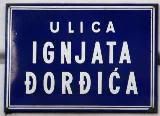
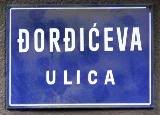
On the first plate, both names are put in genitive (the first and the last name) and in the second, the last name is formed into a possessive and then it of course precedes the noun ulica "street" since it's an adjective now.
People prefer possessives because they behave like adjectives, and for instance almost always refer to streets and squares using possessives. Unfortunately, there no single rule how to make a possessive adjective from a noun.
For m-nouns representing persons (and animals as individuals!), -ov or -ev is added according to the o/e rule. This includes personal names. For example:
Ivan → Ivanov "Ivan's"
brat → bratov "brother's"
mornar → mornarov "fisherman's"
profesor → profesorov "professor's"
Petär → Petrov "Peter's"
kralj → kraljev "king's"
kovač → kovačev "blacksmith's"
prijatelj → prijateljev "friend's"
Similar to adding case endings, ä is lost when adding -ov or -ev. Check also the street names above! For masculine names that end on -o and change like other m-nouns (e.g. Marko), common rules apply, i.e. -o is discarded and -œv is added. This also applies to the name Hrvoje:
Mark-o → Markov
Hrvoj-e → Hrvojev
For a-nouns representing persons (recall, they are almost all of female gender), -in is added, and -a is dropped. Masculine a-nouns (the right column) use the same scheme. For example:
An-a → Anin "Ana's"
mam-a → mamin "Mom's"
sestr-a → sestrin "sister's"
žen-a → ženin "wife's", "woman's"
Andrij-a → Andrijin "Andrew's"
tat-a mª → tatin "Dad's"
gazd-a → gazdin "boss', landowner's"
koleg-a → kolegin "colleague's"
The form of a word without the nominative ending (e.g. -a for a-nouns) is called stem. All endings (for cases, but also for other uses) are normally attached to the stem. The precise definition of the stem is actually a bit more complicated, but I will explain complications a bit later..
Before the added -in, sounds change in stems that end on a -c or -k to -č:
kraljic-a → kraljič-in "queen's"
majk-a → majč-in "mother's"
prijateljic-a → prijateljič-in "(female) friend's"
Don't forget, there are masculine names (e.g. Ivica, Krešo, Mate) that change like a-nouns (i.e. they are mª-nouns). They get the -in ending as any other a-noun:
Ivic-a → Ivič-in
Kreš-o → Krešin
Mat-e → Matin
For more details and a list of common names that fall into this group, check 45 Nouns for Small and Dear.
General Dependence
For nouns representing general, non-personal things another scheme is used. In English, one just says "school bus". In Croatian, you cannot say so. You must make an adjective out of škola f "school" in order to create such a phrase. The adjective is also called "possessive" but it does not stand for any possession really. Again, there's no single way to make it.
For some nouns, including most place names, ending -ski is added to the stem to denote some impersonal dependence regardless of gender of the noun. Some examples are:
grad "city" → grad-ski
Europ-a "Europe" → europ-ski
konj "horse" → konj-ski
kuhinj-a "kitchen" → kuhinj-ski
London → london-ski
ljud-i "men, people" → ljud-ski
mor-e "sea" → mor-ski
mornar "sailor" → mornar-ski
ribar "fisherman" → ribar-ski
škol-a "school" → škol-ski
šum-a "forest" → šum-ski
zim-a "winter" → zim-ski
Warning: possessives are usually not used for names of inhabitants: europski is just an adjective; for a person who lives in Europe, other words are used (see below), unlike English, where "European" can be an adjective, or a person.
Adjectives are never capitalized, as illustrated with europski and londonski. Don't forget possessives are adjectives: they change according to gender, number and the case of the noun. So the translation of "school bus" would be:
školski autobus "school bus"
školska dvorana "school hall"
školsko dvorište "school yard" (dvorište n "yard")
Sjedim u školskom(D) dvorištu(D). "I'm sitting in (the) school yard."
There's one unfortunate complication: for many words, the -ski fuses with the last consonant of the stem, and results can vary:
bolnic-a "hospital" → bolnički
radnik "worker" → radnički
muž "man" (archaic) → muški
sudäc "judge" → sudäčki
Nowadays, muž means only "husband" but previously it meant also "man" (compare žena "woman, wife"), but muški is still the only word that means "male, masculine".
You can see another interesting thing: the ä, that's normally lost before case endings is not lost before -ski!
The summary of sound assimilations with -ski is here:
stem ends on -c, -č, -k -g, -h, -š, -ž -s, -z -ć -b + ski = -čki -ški -ski -ćki -pski
Unfortunately, there are many exceptions (or apparent exceptions) even to these complicated rules:
Pariz "Paris" → pariški "Parisian" (!)
Zagreb (city name) → zagrebäčki (!)
Istra (region name) → istärski "Istrian" (!)
selo "village" → seoski (!)
For some nouns, -ni is added to the stem instead of -ski. Sound changes can occur:
kuća "house" → kućni: kućni miš "house mouse", "domestic mouse"
noć "night" → noćni: noćni miš "nocturnal mouse"
ljëto "summer" → ljëtni: ljëtna vrućina "summer heat"
rad "work" → radni: radni dan "working day"
ruka "hand" → ručni: ručna kočnica "hand brake"
Sometimes there's more than one adjective for a noun. For example, from the noun žena "woman, wife", one can construct two adjectives:
žena → ženin "possessed by a woman/wife"
žena → ženski "female, feminine", "that has to do with all women"
So, one would say:
ženin kaput "wife's coat", "woman's coat" (a coat that's owned by some individual woman)
ženski kaput "women's coat" (a coat that women would buy and wear)
The same thing is mornarov vs. mornarski, profesorov vs. profesorski, etc. For example, an individual car is profesorov if you refer to an individual professor, a particular person; parking places are profesorski if they "belong" to professors in general, i.e. they are for any professor to park there, not just one individual. This is a subtle difference.
For some nouns (meaning living things), the suffix -ji is used for such "general dependance". This suffix causes sound changes a bit similar to -in:
dijëte "child" → djëčji
lav "lion" → lavlji
mačka "cat" → mačji
ptica "bird" → ptičji
zec "rabbit" → zečji
Such sound changes will be explained in detail later. Since they are complex, it's usually easier just to learn the adjective.
It's also interesting that nouns bog "god" and vrag "devil" make possessive adjectives (but also used in general meaning) using -ji:
bog "god" → božji
vrag "devil" → vražji
Unfortunately, there are no clear rules, it's a 'dictionary thing', one has to learn the adjectives. The best illustration of how arbitrary it is, let's compare adjectives related to seasons and directions:
proljëće "spring" → proljëtni (!)
ljëto "summer" → ljëtni
jesen f "autumn" → jesenski, jesenji
zima "winter" → zimski
sjëver "north" → sjëverni
zapad "west" → zapadni
jug "south" → južni
istok "east" → istočni
Possessive Pronouns
Possessive adjectives created from personal pronouns are often called 'possessive pronouns', but they behave and change as other possessive adjectives do.
pers. 1st 2nd 3rd m 3rd n 3rd f sg. ja → moj ti → tvoj on → njegov ono → njegov ona → njen or njezin pl. mi → naš vi → vaš oni → njihov ona → njihov one → njihov
So, njegov means "his". Don't forget it's an adjective.
There's a twist with moj and tvoj: they have more than one form in some cases, normal and 'compact'. There's no difference in use, placement, meaning — use ones you like. Here's the chart for moj (tvoj has exactly the same endings and forms) the special forms are highlighted:
case mª mi n f nom.sg. moj moj moje moja acc.sg. mojeg(a), mog(a) moju dat.sg. mojem(u), mom(u) mojoj gen.sg. mojeg(a), mog(a) moje
The plural is formed according to the common adjective pattern. The 'compact' forms have the -o- endings, since there's an m- or -v- (in e.g. tv-om) before it.
So, these two sentences have the same meaning:
Sjediš u mojem automobilu. "You're sitting in my car." (mojem = dat.sg.)
Sjediš u mom automobilu. "You're sitting in my car." (mom = dat.sg., alt. form)
Next, observe that endings of other possessives must follow the o/e rule, and it applies to naš and vaš (since they end on an -š):
Sjedimo u našem automobilu. "We're sitting in our car." (našem = dat.sg.)
Hladno je u njenom automobilu. "It's cold in her car." (njenom = dat.sg.)
There are important syntactic differences comparing English and Croatian possessives. In English, they are a quite special: you can say "this big cat" but you cannot say "this my cat"; you can say "the cat is big", but you cannot say "the cat is my" — you have to use the word "mine", etc.
In Croatian, it's not so: moj (beside having some special forms you have to learn) behaves exactly as velik "big"; it's perfectly OK in Croatian to say:
ova moja mačka... — literally, "this my cat..."
Ova mačka je moja. — literally, "this cat is my"
Ova mačka je Ivanina. — literally, "this cat is Ivana's"
Next, in English there are words that almost require a possessive in front of them: you cannot say just "leg", "sister", but "my leg", "his sister", etc. Not so in Croatian, you can say basically whatever you want.
Croatian has an additional possessive pronoun svoj (with forms equal to tvoj, so it has alternative forms; it just has an s- instead of t-); it's called reflexive possessive. It's used when the subject of a sentence possesses something:
Sjedim u svojem automobilu. "I'm sitting in my car." (svojem = dat.sg.)
Sjedim u svom automobilu. "I'm sitting in my car." (svom = dat.sg., alt. form)
Again, these two sentences have no difference in meaning whatsoever.
In Standard Croatian, it's mandatory: you cannot use any other pronoun if the subject is the possessor. However, in colloquial speech rules are a bit relaxed in the first and second persons, since there cannot be any confusion. In the third person, the reflexive possessive is very useful. Take a look at the following English sentence:
"Ivan's friend drove his car."
Who does the "his" refer to? Ivan or his friend? Could be both. Croatian resolves such ambiguity by using svoj vs. some other possessive pronoun:
Ivanov prijatelj je vozio svoj auto. if "his" refers to "friend" (the subject)
Ivanov prijatelj je vozio njegov auto. if "his" doesn't refer to "friend" (so, to Ivan!)
Summary
Possessive adjectives
They indicate individual possession ("Ivan's car"), and are created by adding suffixes to the stem:
-œv for m-nouns: Ivan → Ivanov; kralj "king" → kraljev
-in for a-nouns (remove -a): Ana → Anin; tata "Dad" → tatin
Dependence adjectives
They indicate general dependence ("school bus"), and are created by adding one of the following suffixes:
-ski for some nouns and places: škola "school" → školski; grad "city" → gradski
-ni for some nouns: ljëto "summer" → ljëtni
-ji for some (living) nouns: ptica "bird" → ptičji
It depends on the noun which suffix is used. Sound assimilations may occur.
Certain nouns have both adjectives (ženin and ženski) but their meanings differ.
Country and People's Names
This is maybe the right place to introduce country names. For each country, there are three nouns and an adjective in Croatian. The nouns are:
- the country itself ("England"),
- names for male and female inhabitants ("Englishman", "Englishwoman"), shown hare as male ~ female
- the adjective ("English"), also used as a name of the language.
The adjective is never capitalized, nouns always are.
country/
region namemale ~ female
inhabitantadjective
(= language)Africa Afrika Afrikanäc ~ Afrikanka afrički America Amerika Amerikanäc ~ Amerikanka američki Arabia Arabija Arapin, Arap ~ Arapkinja arapski Austria Austrija Austrijanäc ~ Austrijanka austrijski Australia Australija Australäc ~ Australka australski Brazil Brazil Braziläc ~ Brazilka brazilski Britain Britanija Britanäc ~ Britanka britanski Belgium Belgija Belgijäc ~ Belgijka belgijski Bosnia Bosna Bosanäc ~ Bosanka bosanski Bulgaria Bugarska * Bugarin, Bugar ~ Bugarka bugarski Canada Kanada Kanađanin ~ Kanađanka kanadski China Kina Kinez ~ Kineskinja kineski Croatia Hrvatska * Hrvat ~ Hrvatica hrvatski Cyprus Cipär Cipranin ~ Cipranka ciparski Czech Češka * Čeh ~ Čehinja češki Dalmatia ‡ Dalmacija Dalmatinäc ~ Dalmatinka dalmatinski Denmark Danska * Danäc ~ Dankinja danski Egypt Egipat Egipćanin ~ Egipćanka egipatski England Engleska * Englez ~ Engleskinja engleski Finland Finska * Finäc ~ Finkinja finski France Francuska * Francuz ~ Francuskinja francuski Germany Njëmačka * Nijëmäc ~ Njëmica njëmački Greece Grčka * Grk ~ Grkinja grčki Herzegovina Hercegovina Hercegoväc ~ Hercegovka hercegovački Hungary Mađarska * Mađar ~ Mađarica mađarski India Indija Indijäc ~ Indijka indijski Ireland Irska * Iräc ~ Irkinja irski Istria ‡ Istra Istranin ~ Istranka
Istrijan ~ Istrijankaistarski Italy Italija Talijan ~ Talijanka talijanski Latvia Latvija Latvijäc ~ Latvijka latvijski Lithuania Litva Litaväc ~ Litavka litavski The Netherlands Nizozemska * Nizozemäc ~ Nizozemka nizozemski Norway Norveška * Norvežanin ~ Norvežanka norveški Poland Poljska * Poljak ~ Poljakinja poljski Portugal Portugal Portugaläc ~ Portugalka portugalski Romania Rumunjska * Rumunj ~ Rumunjka rumunjski Russia Rusija Rus ~ Ruskinja ruski Scotland Škotska * Škot ~ Škotkinja škotski Serbia Srbija Srbin ~ Srpkinja srpski Slavonia ‡ Slavonija Slavonäc ~ Slavonka slavonski Slovakia Slovačka * Slovak ~ Slovakinja slovački Slovenia Slovenija Slovenäc ~ Slovenka slovenski Spain Španjolska * Španjoläc ~ Španjolka španjolski Sweden Švedska * Šveđanin ~ Šveđanka švedski Turkey Turska * Turčin (see note) ~ Turkinja turski Wales Vels Velšanin ~ Velšanka velški
All country names marked with an * change case as (possessive) adjectives. Names marked with an ‡ are regions within Croatia. Sometimes inhabitants of the region use a different name for them than the rest (e.g. Istrijan locally).
Bosnia and Herzegovina are regions of Bosnia and Herzegovina (usually abbreviated as BiH).
All male inhabitants have always only short plural: Grk — Grci. Names for male inhabitants that end on -in have the plural just on -i. Noun Turčin "Turk" has plural Turci etc. (its root is actually Turk-). All nouns follow the common gender rules, no exceptions or i-nouns here, just plain a-and mª-nouns.
nom.sg. Srbin Rus Turčin Irska acc.sg. Srbina Rusa Turčina Irsku dat.sg. Srbinu Rusu Turčinu Irskoj gen.sg. / dual Srbina Rusa Turčina Irske nom.pl. Srbi Rusi Turci — acc.pl. Srbe Ruse Turke — dat.pl. Srbima Rusima Turcima — gen.pl. Srba Rusa Turäka —
Examples and Exercise
Some examples:
Hrvati uče engleski (jezik). "Croats are learning English (language)."
Ja säm Amerikanka. "I'm (an) American (woman)."
Francuski predsjednik je doputovao u Hrvatsku. "(The) French president has arrived to Croatia."
Većina Amerikanäca živi u gradovima. "Most Americans live in cities." (lit. "Most of Americans...")
JavaScript must be enabled. You don't have to use my special notation (i.e. ä, ë) in answers, normal spelling will do as well. Letter case is ignored.
Updated 2014-09-24 (v. 0.4)

47 comments:
I really appreciate this site!! If you explain the use of 'svoje' anywhere, can you direct me to it? (povratno-posvojna zamjenica)
Thank you
I agree it needs explaining. I just don't know if it's better to explain it here or when I explain the pronoun se.
Please give me a day, I will explain it here.
lp Daniel
Thank you, looking forward to it...
I did it already, see above.
lp Daniel
Wonderful, so helpful! Hvala!
Well you can help me by pointing to everything that's not clear.
I have already decided to expand this post a bit. But frankly I'm not sure that everything is well explained.
The possessive reflexive was already explained elsewhere: where the reflexive pronoun is explained. That's maybe a bit too late.
br Daniel
In your statement, you say "possessives are derived from a single noun. If you want something to be possessed by "two word things" you must use genitive! So you really cannot make a compound possessive like 'my sister's' in Croatian, you can say just 'sister's'.", do you mean that if you say "Moja sestra knjige",(I think i have word order mixed up) that is in Nominative and Genitive? And a possessive example would be like (Knjigin stol) meaning "The book's table". Also when you use (Moj) does that make things nominative or genetive?
You cannot say moja sestra knjige in Croatian at all, you can only say knjige moje sestre (this order of words is mandatory) where the last two words are in genitive. The word moj is an adjective and does not require the noun to be put in any case at all; it works the other way around: it adapts to the case of the noun, like:
pišem mojoj sestri "I'm writing to my sister" -- the last two words are both in dative.
if you put a noun after an adverb, preposition etc. you must use a specific case; but if you put an adjective in front of a noun, it does not affect it; the adjective adapts to the noun instead!
In your example, (Sjedim u svojem automobilu. "I'm sitting in my car." (svojem = dat.sg.)), I'm curious as to of where you get the (em) out of (svoj"em"). It doesn't tell me how to use case endings for possessive pronouns. Same thing goes for (Hladno je u njen"om" automobilu.). Where did the -om- come from in (njenom). P.S Sorry if im being picky with this. I'm considering Croatian to be my 2nd language and I find it personally to be fun but informative also with a challenge :)
Since moj ends on -j, according to the o/e rule, it gets -e- in certain endings instead of -o-. I also wrote above:
"Don't forget it's an adjective. Also, observe the ending variations according to the o/e rule."
However, I will re-explain it here since I find it confusing a bit. Thanks for pointing this out.
I noticed it when you were introducing reflexive possessive's and when they had a certain kind of ending atthe end of them.
How can I tell when to use -e- or -o- when constructing a sentence like(Hladno je u njen"om" automobilu.) or (Hladno je u njen"om" automobilu.). Do i use instrumental case endings?
I found this chart online about possessive pronouns, though it may say Serbian, is this the same as Croatian possessive pronouns?
http://www.lztranslation.com/pdf/serbian-possessive-pronouns.pdf
Yes, they are exactly the same, although mine is better :) The other chart is way too complicated and hides e.g. how cases are similar; it does not contains plural forms of possessives themselves, but just endings listed; and it contains a few errors! Instead of "vaš-im" (-im, -om / -im, -im, im), there should be "vaš-em" (-em, -oj / -im, -im., -im).
I would not advice using charts from lztranslation.com -- they are way too complicated and sometimes contain inconsistencies, errors etc.
The best is to remember that possessives change as any other adjective + some special forms for moj, tvoj, svoj, in sg. m/n.
Doesn't possessive pronouns use the same endings as adjectives though?
Yes they do, and moj, tvoj, svoj have additional compact forms.
Ok, so since the possessive pronouns use the same exact ending as adjectives, then what are the additional compact forms for (moj, tvoj, svoj)? Also what are the special forms for the 3 (moj, tvoj, svoj) in sg. m/n
These additional or compact forms are forms that appear in some sg. m/n cases.
e.g. moj
Normal form, dat. sg. m: mojem (--em, not -om since it ends on -j)
Additional (compact) form for dat. sg. m mom
Is it clearer now?
Yeah I understand how this works now. But how would the sentence for example (Ja sam u Azri Kuci) meaning (I'm at Azra's house)DAT with being that Azra's house is in possession of Azra, would I say (Ja sam u Azrin kuci)? Which is more grammatically correct? Same goes for the sentence (Ja sam u Azru kucu), meaning (I'm going to Azra's house)ACC. Would I say (Ja sam u Azrin Kucu) to still show that Azra is in possession of the house?
Neither is correct. The adjective is Azrin.
The basic sentence is ja sam u kući where kući is dat. (or loc., it's the same).
Now you must put the adjective into dat. sg. f, and if you check the table of endings, the right ending for adjectives is -oj, therefore:
ja sam u Azrinoj kući
for masculine nouns, e.g. stan "apartment", you would use:
ja sam u Azrinom stanu
Is it clear? All adjectives must follow number (sg/pl), case and gender of the noun they are in front of.
As for the second sentence, you should insert acc. sg. f of Azrin — Azrinu:
Ja idem u Azrinu kuću
You should say "go" (idem) instead of "am" (sam)
This is making great sense, thanks. So, same rule applies to masculine adjective nouns?
There are no "masculine adjective nouns" — a word can be a noun, an adjective, or something else (verb, etc).
If you meant possessive adjectives (adjectives made from nouns, e.g. Ivanov, Azrin... — yes, they behave as any other adjectives, like "big" or "green".
In your example (Sjedim u svojem automobilu), it demonstrates the use of Reflexive possessive. Can I say e.g (Sjedim u mojem automobilu). Can I use "my" as the possessive?
Yes, you can, and people do, it does not sound bad. However, Standard prefers svojem.
For the 3rd person, (e.g. Ivan sjedi u svojem automobilu) it's the preferred way of expression.
If `svojem` is standard, then how in this example (Sjediš u mojem automobilu) am I using "Mojem" and not "Svojem"? Can either Moj or svoj be used in either case, except 3rd person which svoj is standard?
It's colloquial, in everyday speech, not Standard.
In Standard, there should be always only svojem. In colloquial talk, rules are relaxed.
Over all, I can use moj to declare a possessive instead of svoj? Can people say e.g (Svoja jabuka) and make it say (My apple) or is it crucial that it's (Moja jabuka)?
No, nothing is crucial, the whole issue is not really that important.
-Is it proper to say (Ja sam s njegovom knjigom)"I am with his book"? Because I'm not sure is the first part sounds proper to say.
-How can I tell when to use the (-ni) and (-ji) suffixes?
What should it mean? There's no clear-cut rule what word uses -ni and what -ji, however I will include adjectives of often-used nouns in the word list. It's under construction here: http://small-croatian-dictionary.blogspot.com/2014/04/z.html please let me know what do you think about it.
a few days ago, i checked it out and it was just a bit confusing, and when I go back to look at it, it says the blog was removed. So, there really isn't a way to check when to use -ji or -ni for possessive endings.
I think it's less confusing now. I moved it to basic-croatian-dictionary.blogspot.com
For each noun, there's a corresponding "possessive" adjective, if one is really used, e.g.
vino n wine
~ vinski adj.
I checked it out and some things on there are confusing like e.g (< N A (na A1) >)
It means, when you want to say, "Ana is throwing things at Ivan", you would say Ana (N) baca stvari (A) na Ivana (A1), N, A etc. are case assignments (nom., acc. etc.) and if there's more than one word using the same case they are distinguished by indices (1, 2...). Would an example help you? Daniel
yes, please. So I can get more of a base understanding.
Do you think this is understandable?
http://basic-croatian-dictionary.blogspot.com/2014/04/0.html
Yeah, i get it.
Any chance you can add Canada to the list?
Yes, here it is: Kanada, Kanađanin, Kanađanka, kanadski. I will add it. br Daniel
Sorry to bother you again, Daniel. Would someone from Mostar call themselves a Hercegovinac instead of Bosanac? If yes, what would be the female version and adjective? Thanks for everything.
He would call himself Hercegoväc (the ä is just my mark for the "inconstant a"), and the female version would be Hercegovka (to verify, Google for both). I will add it to the table! br Daniel
Thank you!!!
How would you do possessives with names ending in "i"? I'm thinking especially for foreign names (Alexei, Cori, Heidi, etc.) - either male or female - and nicknames.
It's a bit more complex, essentially such names are either understood/pronounced as ending on a consonant (e.g. Alexei would be understood Alexej and given an -ev), but there are male common names/nicknames that end on -i (Toni, Robi, Bobi) or -e (Ante, Jure). Basically, masculine names on -i would get -jev (Tonijev), and female names on -i would get just an -n (Heidin).
I must explain it somewhere, such names are explained in
http://basic-croatian.blogspot.com/2009/09/56.html
and I will explain such possessives there are possibly change the name of the chapter (It's a bit misleading now). Please ask any questions you would like answered.
br Daniel
Thank you! I guessed female i-names would just be given an 'n' (keep it simple!), it was the male names that had me stumped. I now see the explanation in #56 - sorry for jumping the gun. If I think of any other questions, I will ask. Thanks again for all your time and dedication.
I am afraid of oversimplifying things :( The problem is that -in causes the consonant alternation c -> č so there could be a principle a feminine name that ends on -ci and probably then you would get -čin in the possessive. But that change is not really regular...
Masculine names that behave as a-nouns get -in as well but usually there's no alternation (e.g. Braco -> Bracin).
This blog is in constant improvement. Please point to any inconsistencies you find.
Post a Comment