Bosnian, Serbian and Montenegrin are separate standard languages that are quite similar to the Standard Croatian (some people consider them 'variants' of a single language).
The Cyrillic Alphabet
The first difference is that Serbian and Montenegrin use another alphabet — Cyrillic. However, there is an 1:1 correspondence between Croatian Latin and Serbian Cyrillic:
Serbian Cyrillic А а Б б В в Г г Д д Ђ ђ Е е Ж ж З з И и Croatian Latin A a B b V v G g D d Đ đ Ee Ž ž Z z I i
Serbian Cyrillic Ј ј К к Л л Љ љ М м Н н Њ њ О о П п Р р Croatian Latin J j K k L l LJ lj M m Nn Nj nj O o P p R s
Serbian Cyrillic С с Т т Ћ ћ У у Ф ф Х х Ц ц Ч ч Џ џ Ш ш Croatian Latin S s T t Ć ć U u F f H h C c Č č DŽ dž Š š
Observe that the Cyrillic alphabet has a different order of letters than Latin. I have highlighted characters that are really different than Latin.
In reality, in today's Serbia the Cyrillic alphabet is mostly used in official and ceremonial uses. Majority of newspapers are published in 'Serbian Latin' (identical to 'Croatian Latin') script. Web sites published in Cyrillic have usually a 'LAT' button somewhere. For instance, Politika daily has pages both in Cyrillic and Latin (check CYR and LAT links on top), but B92 TV is in Latin only. Even the web site of Serbian government has links ћирилица "Cyrillic" and latinica "Latin" on the top (Cyrillic is chosen by default).
It's interesting to note that some Serbs are afraid that the Cyrillic script will fall out of use and consequently, they think, Serbs will 'lose their identity'.
There are few differences in spelling (both in Latin and Cyrillic). The first one is spelling of foreign names. Serbian and Montenegrin usually respell them using approximated pronunciation:
Serbian spelling original Njujork / Њујорк "New York" Džordž Buš / Џорџ Буш "George Bush" Čikago / Чикаго "Chicago"
The second one is spelling of the future tense. When an infinitive on -t is immediately followed by an auxiliary ću, ćeš... it's spelled together, and the infinitive-final -t is discarded:
Croatian Serbian pisat ću pisaću / писаћу reći ću reći ću / рећи ћу
Serbian vs. Croatian
People usually associate Ekavian Štokavian (mlëko, lëpo) — not Ijekavian (mlijëko, lijëpo) — with Serbian, but it's not really true, since Serbs use both as Standard: most Serbs outside of Serbia (e.g. Bosnia and Croatia) and in some parts of southern Serbia use Ijekavian Štokavian and Serbs in most of Serbia, including Belgrade, use only Ekavian Štokavian. You can find both in Serbian newspapers. The Serbian Standard is much less strict than Croatian, there is a bigger choice of "acceptable" variants.
If you find a 'dictionary of differences' listing bijëli as 'Croatian' vs. beli as 'Serbian' you can immediately conclude it's oversimplifying things (and listing completely predictable differences!).
Serbian has some specific nouns and adjectives which are almost never used in (Standard) Croatian — at least in the meaning used in Serbian. For instance (Croatian equivalents are in curly braces {...}):
bešika "bladder" {mjëhur}
bezbjëdan adj. "secure, safe" {sigurän}
čas "lecture, class in school" {sat}
fabrika "factory" {tvornica}
fudbal "football" {nogomet}
gas "gas" {plin}
lenjir "rule (to draw lines)" {ravnalo}
nedjëlja "week" {tjëdan}
ostrvo "island" {otok}
pijaca "farmer's market" {tržnica}
sedmica "week" {tjëdan}
sprat "floor (of a building)" {kat}
talas "wave" {val}
tašna "handbag, purse" {torba}
točäk "wheel" (not "steering") {kotač}
uslov "condition, prerequisite" {uvjët}
vazduh "air" {zrak}
voz "train" {vlak}
Here Serbian words are given in Ijekavian forms, it's trivial to obtain Ekavian forms that are normally used in Serbia.
Especially, terms related to cooking, food, and standard house items show numerous differences; these terms are often completely unknown outside their 'territory':
boranija "green beans" {mahune f pl.}
časovnik "clock" {sat}
čaršav "bed sheet" {plahta}
ćebe (gen. ćebeta) "blanket" {deka}
džigerica "liver" {jetra}
hljëb "bread" {kruh}
kašika "spoon" {žlica}
makaze f pl. "scissors" {škare f pl.}
peškir "towel" {ručnik}
pirinač "rice" {riža}
praziluk "leek" {poriluk}
supa "soup" {juha}
šolja "cup (for tea, coffee)" {šalica}
šargarepa "carrot" {mrkva}
There are several specific verbs as well:
ćutim, ćutao "be silent" {šutim}
pomjëram ~ pomjërim "move, shift" {pomičem, pomicao ~ pomaknem}
Next, in Serbia there some often-used 'hypochorisms' (that is, nicknames) for men on -a: Pera (from Petär), Vlada (from Vladimir and similar), Brana (from Branislav), etc., all behaving as a-nouns. They are quite rare in Croatia, where forms Pero, Vlado, etc. are preferred.
Adverbs puno/jako vs. mnogo are characteristic in meaning "a lot", "very". Of course, vrlo can be used as well, but it's not used in speech much. The use of these adverbs is different in Croatian and Serbian:
Puno hvala! "Thanks a lot." (Croatian only)
Mnogo hvala! "Thanks a lot." (Serbian, sometimes Croatian)
Jako säm umorna. "I'm very tired." (Croatian only)
Mnogo säm umorna. "I'm very tired." (Serbian only)
Vrlo säm umorna. "I'm very tired." (both languages, but not often used)
Observe that mnogo is normally used in both Croatian and Serbian meaning "much" before comparatives: mnogo veći "much bigger". This is a subtle difference.
Different 'cultural' terms indicate that Serbian and Croatian cultures developed separately. Some words used in Standard Serbian are acceptable in Croatian as colloquial words, and some of them are quite frequent in Croatia:
pegla "iron (for cloth)" {glačalo}
putär, puter "butter" {maslac}
paradajz "tomato" {rajčica}
hiljada "thousand" {tisuća}
Some words have only a slightly different form due to different adaptation of foreign words (this table includes only characteristic words showing ways words differ):
Croatian Serbian meaning akcent akcenät "accent" fašist fašista mª "fascist" gripa grip "flue" kemija hemija "chemistry" kaos haos "chaos" funkcioniram funkcionišem, funkcionisao "function" (verb) milijun milion "million" minuta minut "minute" ocean okean "ocean" sekunda sekund "second"
Verbs ending on -išem, -isao are very characteristic of Serbian; in Croatian, there's only one such verb: mirišem, mirisao. (You will maybe read elsewhere that Serbian has an -a in many words where Croatian does not. It's so for some words, but for some others, it's the other way around!)
Some words differ only in one sound, or endings; sometimes gender is changed (v. = verb, v.p. = verb pair):
Croatian Serbian meaning jučer juče adv. "yesterday" korišten korišćen adj. "used" kuham ~ s- kuvam ~ s- v.p. "cook" lani lane adv. "last year" lijën lenj adj. "lazy" naočale f pl. naočare f pl. "glasses" opći opšti adj. "common" spominjem ~
spomenempominjem ~
pomenemv.p. "mention" promatram posmatram v. "watch, look at" shvaćam shvatam v. "understand" sretan srećan adj. "happy, lucky" sol f so f "salt" svećenik sveštenik "priest" večer f veče n "evening" točka tačka "point, dot"
Different t vs. ć in Croatian and Serbian don't really have an underlying logic, as you can see. It's just so, must be remembered word-by-word.
Warning: there are many 'dictionaries of differences' in printed form and even more on the Internet that simply list Serbian and Croatian words. Most of them are completely worthless. For instance, razlikovnirjecnik.blogspot.com lists češalj ("comb") as a 'Serbian' word with the Croatian equivalent — češalj (exactly the same word!). It also lists many dubious and invented pairs, but doesn't list e.g. sekund — sekunda! Simply ignore such word lists you may find floating around.
Serbian shows many characteristics of Štokavian dialects:
- it frequently losses the initial h, like in istorija "history", otherwise changes it to j or v (e.g. suv "dry")
- final -l is always lost (even in sol and stol: so and sto)
- some words are simplified (e.g. ko vs. tko "who").
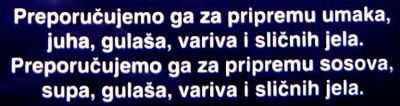
As an illustration, here are double descriptions from a tube of tomato paste, Croatian at top, Serbian at bottom (I actually took photos of a tube):

Montenegrin and Bosnian/Bosniak
Montengrin uses more or less the same vocabulary and spelling conventions as Serbian, but only the Ijekavian variant. It uses few specific forms, like nijësmo vs. Croatian/Serbian nismo "we aren't". Recently the Montenegrin alphabet adopted two additional letters:
Montenegrin Cyrillic Ć ć З́ з́ Montenegrin Latin Ś ś Ź ź
In a case that your computer cannot render these characters, they look like a S and Z (both Cyrillic and Latin versions) with an additional stroke over it, resembling Ć. They are 'softened' variants of š and ž. The new characters are not much used, the web site of the Government of Montenegro doesn't use them (and is by default in Latin, but can be switched to Cyrillic!).
Bosnian (or: Bosniak, there's a dispute over name) is similar to Serbian, but uses only Latin script and Ijekavian. Two spelling differences (e.g. Njujork and imaću) are used sometimes in Bosnian, but it seems that Croatian versions occasionally prevail (New York, imat ću). Bosnian sometimes freely mixes Croatian and Serbian terms, so both tisuća and hiljada "1000" seem acceptable.
Since Bosnian is a standard used by Bosniaks which are predominantly Muslim, there are lot of oriental and Islamic terms. Sound h is always retained, even where Croatian does not. There are some specific terms, e.g. daidža "uncle" {ujäk}.
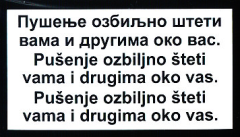
Bosnia-Herzegovina is today officially tri-lingual, as evidenced by this warning on a box of cigarettes that displays three identical sentences (the first one is just in Cyrillic; I have taken a photo of an actual box):
Updated 2014-06-06 (v. 0.4)

5 comments:
Polish has had the letters ś, ź for centuries. (The letter ć is a loan letter from Polish added to the Serbian-Croatian language system in the 19th century) In what cases are these letters used? In Polish for example: BoŚniak - Bosniak; Święty(śvjenty) - Saint, Holy; śmiały - courageous; śmiech (pronounced śmjeh) - laughing; śmieszny - funny; śliwka - plum; śliwowica - slivovica; śpiew - singing; średnia - average; świat - world; śmierć - death; ślepy - blind. "Ź" is less used, but it is also common "źrebak" - colt, young male horse; źródło - spring; źrenica - pupil of the eye.
One thing to add - all verbs with infinitive ending with -ći/ћи in Serbian are always written separately from 'hteti' enclitics (ću, ćeš, će...). The only right way is to spell 'reći ću' or 'doći ću', for example, is separately. Forms like 'rećiću' are incorrect.
BTW, a very nice blog, this. It's very interesting to see an American tackle Slavic linguistics.:)
Hm, hvala, osim što nisam Amerikanac :) Svakako ću popraviti to... sad vidim da je greška! lp Daniel
But you forgot one letter: Đđ wich is dź in polish
These languages are very similar. But to one who doesn't speak Serbian or Croatian it looks very diferent. Basiclly if you know one language you can say legit that you know the other one too.
Very interesting blog.
Post a Comment